

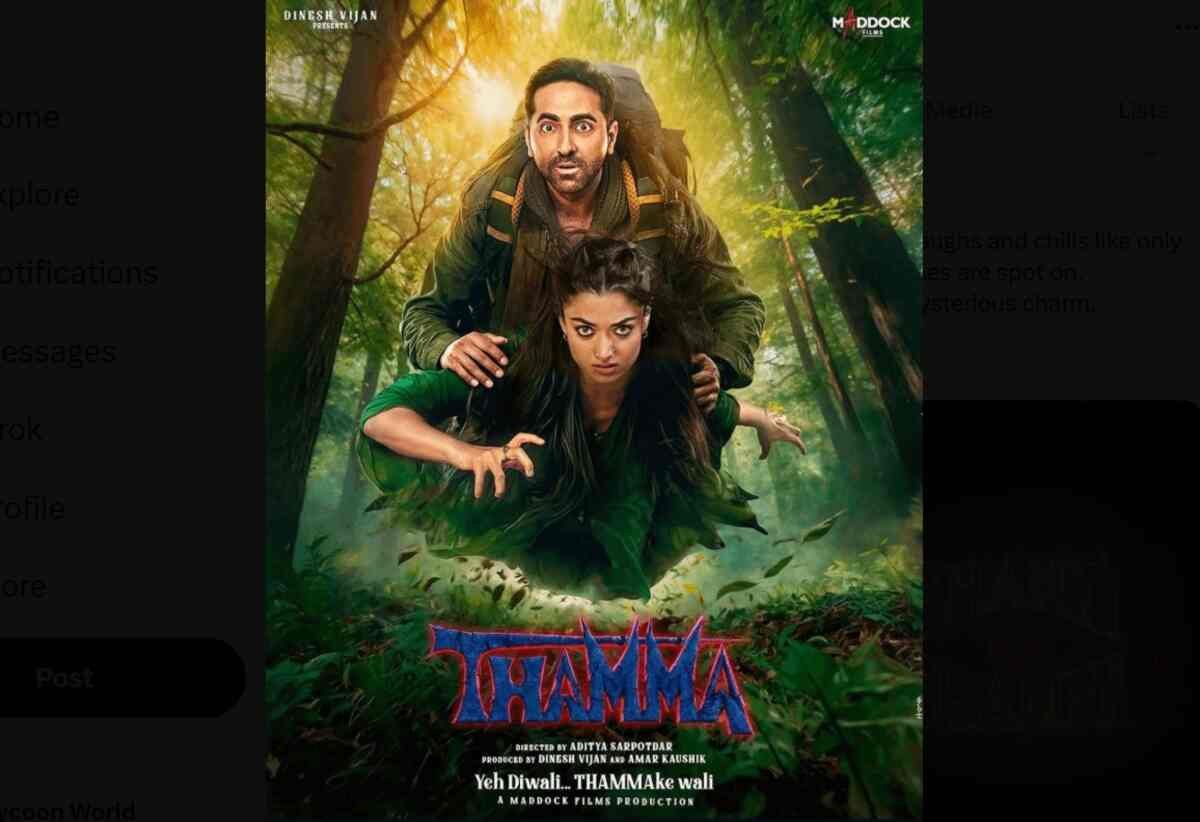
The “Maddock Horror Comedy Universe,” which began with Stree in 2018, has become one of the most successful and innovative cinematic universes in Indian cinema. With films like Bhediya, Munjya, and Stree 2, audiences have been treated to a delightful mix of horror, humor, and folklore. Each film expanded the mythos, introducing new creatures, curses, and worlds drawn from the depths of Indian legends. Into this already rich universe enters Thamma, directed by Aditya Sarpotdar and starring Ayushmann Khurrana and Rashmika Mandanna. Billed as a Diwali “vampire saga,” Thamma promised to be a firecracker of a film—but sadly, it fizzles out before it can truly spark.
Plot: A Love Story Between the Living and the Undead
The story of Thamma begins centuries ago, in the era of Sikandar, when a fateful encounter with the Betaals—undead creatures from folklore—sets the tone for the curse that follows. Fast forward to the present day: Alok Goyal (Ayushmann Khurrana), a witty and somewhat arrogant Delhi-based researcher, ventures into a mysterious forest with his friends to uncover the truth about ancient mythical beings. What begins as a harmless exploration turns into a nightmare when they encounter a werewolf. Alok, injured and lost, is rescued by Tadaka (Rashmika Mandanna), a mysterious woman with an otherworldly aura.
Unbeknownst to Alok, Tadaka is connected to Yakshasan (Nawazuddin Siddiqui), the powerful Thamma of the Betaal clan—a ruler of the undead who guards his territory with brutal force. Alok brings Tadaka to Delhi, unaware of the storm he has invited into his life. As the city lights up for Diwali, shadows creep in, and Tadaka’s true identity begins to unravel. Who is she really—a cursed being, a vampire, or something far beyond human comprehension?
While Alok’s father (Paresh Rawal) grows increasingly suspicious of her, Alok is blinded by love. Soon, Yakshasan’s henchmen invade the human world to retrieve Tadaka, leading to a chaotic clash between humans, vampires, and other supernatural creatures. What could have been a thrilling blend of mythology and emotion, however, collapses under weak writing and disjointed storytelling.
Direction and Writing: When Vision Doesn’t Meet Execution
Aditya Sarpotdar, who successfully directed Munjya, attempts to craft a mythical romance interwoven with supernatural horror. The premise—a love story between a human and a vampire-like being rooted in Indian folklore—had immense potential. Unfortunately, Thamma fails to translate that idea into an engaging narrative.
Unlike Stree, which balanced humor and horror perfectly, Thamma struggles to maintain tonal consistency. The film’s first half rushes through character introductions, focusing more on setting up future films than establishing emotional depth. The second half tries to tie multiple threads—cameos, world-building, and mythological exposition—but ends up feeling cluttered and incoherent.
There are fleeting moments of brilliance—especially in scenes where Tadaka wrestles with her duality, torn between love and curse—but they are few and far between. Instead of creating a tightly-knit story, the screenplay feels like a patchwork of ideas competing for attention.
The universe-building, which once felt organic, now appears forced. Every cameo feels like a commercial break rather than a natural extension of the story. Aditya Sarpotdar’s direction shines in a few visually rich sequences, particularly in the jungle scenes and Tadaka’s transformation moments, but these glimpses of creativity cannot save the film from its erratic pacing and underdeveloped plot.
Performances: Strong Cast, Weak Script
Ayushmann Khurrana, known for his impeccable comic timing and emotional depth, gives his best to the role of Alok Goyal. He portrays the arc from a confident, flirtatious Delhi boy to a man confronting supernatural horrors with conviction. Yet, even his charisma can’t overcome the film’s weak dialogues and lack of narrative cohesion. His chemistry with Rashmika Mandanna feels forced and underwritten, missing the intensity and passion the story demands.
Rashmika Mandanna as Tadaka is the film’s biggest strength. She embodies both vulnerability and mystery with ease. Her expressive eyes convey Tadaka’s eternal loneliness and the moral conflict of a creature yearning for humanity. In her first well-fleshed-out Hindi role, Rashmika shines, proving she can handle layered characters. However, she is often let down by inconsistent writing and a screenplay that doesn’t allow her character to fully bloom.
Nawazuddin Siddiqui plays Yakshasan with his trademark eccentricity, but his performance oscillates between menacing and cartoonish. The writing gives him little room to explore depth; instead, his character is reduced to exaggerated gestures and awkward humor that fails to land.
Paresh Rawal, cast as Alok’s father, brings a few laughs but feels wasted in a one-dimensional role. Geeta Aggarwal and Faisal Mallik lend brief but credible performances in supporting parts.
Technical Aspects: Style Over Substance
Visually, Thamma is an ambitious project. The cinematography captures the eerie, mist-filled forests and the darkly beautiful landscapes with flair. The VFX, while decent, lacks the finesse seen in Bhediya or Stree 2. Some sequences, particularly the transformation scenes, feel rushed or unfinished.
The background score by Sachin–Jigar tries to elevate the mood but becomes overbearing in emotional moments. The music doesn’t stick—there are no memorable songs or haunting melodies that stay with you after the credits roll. Editing is another weak point; abrupt cuts disrupt the rhythm, and the climax feels hurried.
The action sequences—especially the Bhediya vs. Betaal showdown teased in the trailers—are visually exciting but poorly choreographed in execution. Instead of delivering tension and thrill, they feel repetitive and predictable.
Themes and Missed Opportunities
At its heart, Thamma tries to explore timeless themes—love versus duty, humanity versus monstrosity, and the curse of immortality. The idea of reimagining vampires through an Indian mythological lens is refreshing. The film could have dived deeper into cultural folklore, questioning whether ancient curses and modern love can coexist. Unfortunately, these philosophical undertones remain surface-level.
The film also tries to comment on societal issues—like women’s safety in Delhi and the greed of modern science—but these are fleeting, token gestures. Unlike Stree, which used satire to highlight gender dynamics, Thamma’s attempts at social commentary feel tacked on rather than organic.
What Works
-
Rashmika Mandanna’s performance and screen presence.
-
A few humorous moments and clever one-liners.
-
Visually engaging set pieces in the first half.
-
A promising concept rooted in Indian mythology.
What Doesn’t
-
Weak, uneven screenplay with too many subplots.
-
Forced cameos and clunky universe-building.
-
Lack of chemistry between leads.
-
Predictable and underwhelming climax.
-
Poorly developed antagonist and rushed pacing.
Final Verdict: A Toothless Vampire Tale
Thamma had all the ingredients to be a thrilling addition to Maddock’s horror-comedy universe—a stellar cast, an intriguing premise, and the backing of a successful franchise. Yet, it ends up being the weakest link in the chain. While Ayushmann Khurrana and Rashmika Mandanna try to keep the film afloat, the hollow writing and inconsistent direction drain it of emotional and cinematic energy.
What should have been a Diwali blockbuster turns out to be a dimly lit lamp—flickering with promise but ultimately extinguished by its own lack of bite.
⭐ Rating: 2 out of 5 stars
Watch it only if you’re a fan of the Maddock universe or Rashmika’s performances. Otherwise, this vampire flick is better left buried in the shadows.

